


Restoration of Former Words and Phrases Based On Older Spanish Bibles Before 1909

RESTORATION OF FORMER WORDS AND PHRASES BASED ON OLDER SPANISH BIBLES BEFORE 1909
By CA Donate
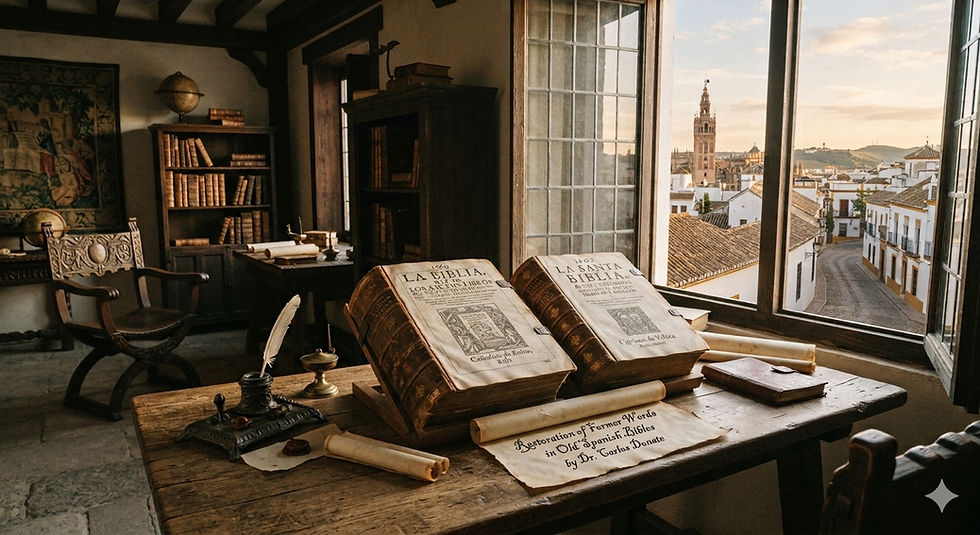
Introductory remarks
Restoration is the method of identifying a word or phrase that once appeared in older Spanish Scriptures, which were removed in modern times based on the fallacious Alexandrian philosophy. Restoration means that the Reina Valera Gomez (RVG) put back what modernists and textual critics removed, especially in the late 19th Century all the way to the mid-20th Century. By careful and deliberate collation and proper translation which began over 30 years ago, the result is a Spanish Bible which is faithful to the Traditional Text and the KJV. I am honored to be a follower of the RVG and had the honor to be a part of the team of collaborators directed by my friend Dr. Humberto Gomez, its editor.
Why restore?
Because the criticism being leveled against the RVG that it is a novelty Bible is untrue.
Because sources or witnesses abound! Sources such as older editions of the Spanish Scriptures dating as far back as 10th Century, but especially in the 1200´s.
Because “matching” old words and phrases to the Traditional Text is not a bad thing! Some critics call the RVG Bible a “ruckmanite” Bible, which simply is untrue. English phraseology and style was not forced into the RVG. Even so, it was the intent of Reformation scholars such as Erasmus, Beza, Stephens, Elzivir, and other Bible believers to match witnesses and find a common denominator, or a unified text, which is divinely preserved, and provide such a document to all. Ironically, a “matching text” is also the intent of the Critical Text community. In their case, it is a match “not made in Heaven”!
Because older editions of the Spanish Bible were used of the Lord to bring the light of the Gospel in Spanish countries where the Bible was forbidden. Spanish Bibles were being produced outside of Madrid in cities like New York, and Buenos Aires to keep up with the demand.
Because there are also ancient non-Spanish translations such as the Aramaic (Syriac or Peshitta) as well as Reformation era foreign language Bibles which include many of the words and phrases that are part of the Traditional Text (Hebrew and Greek) but were omitted for some reason or another in certain Spanish Bibles.
Because the RVG team of collaborators were accused of “not being fluent in Hebrew, Greek or Latin”, therefore “disqualified”. This has nothing to do with restoration. This paper will demonstrate that these restorations were based on already existing Spanish Bibles, so there was no need to be a “scholar” in biblical languages. Nevertheless, in cases where consultation of Hebrew, Greek and Latin language was necessary, the RVG did have qualified experts such as Dr. Rex Cobb, Dr. D.A. Waite, and others who made sure that the translation being made was according to the rules of these languages and the Traditional Text.
The story of the Spanish Bible goes as far back as the pre medieval times when Sephardic jews as well as romanced Latins dwelt in the Iberian peninsula. Since then, there have been innumerable attempts to revise a word or a phrase by many people. Even Jerome himself (and groups of men, such as the Carthage Council) back in the late 4th Century, tried to standardize all existing old Latin manuscripts into one big Bible, the Vulgate. Bible believers know today that he ignored the total sum of manuscript evidence (+5000), plus he had his own Catholic agenda to fulfil by rejecting the more faithful witnesses in Old Latin. The Vulgate became the official Bible within Spain and its dominion for hundreds of years. No one dared question its “authority”, at least not openly. There were, nonetheless a few Catholic revisors that would from time to time express their differences with a word or a phrase saying that the Hebrew Masoretic text was better, and more faithful. With the coming of the Reformation era, scholars such as Erasmus began to openly question the witnesses for a text that was traditional, that is, universally recognized outside the limited and biased scheme of the Vulgate. The time had come to revise and restore the true text.
Textual evidence within the Traditional Text of Scriptures dating as far back as the 13th Century in Spain is an undeniable fact in favor of Bible believer´s convictions for a pure and perfect Bible, and impossible to refute considering modernist scholasticism which contaminated the science of biblical translation since the 1880´s. The wisdom, sagacity and understanding of older scholars, revisors and translators far exceed today´s modernist bias, and knowledge.
Throughout the history of translation and revision of the Spanish Scriptures, which begins in the 10th Century, there were men who remained closer to the Traditional Text than others. The embracement of the Traditional Text stand in stark contrast with today´s modern Bibles, and it reflects each person´s personal convictions. Unfortunately, not all modern Hispanic Baptists agree with the Traditional Text. Some have decided to follow the critical reading, or an outright omission. Why would an independent, fundamental KJV Baptist even consider embracing an ecumenical Bible produced by the United Bible Societies?
This is why the RVG is so important. Dr. Humberto Gomez and his collaborators have been “of one accord” (Acts 1:14 et al.), especially as it relates to textual matters throughout its entire process. The RVG isn´t comprised of a multi theological mixture of beliefs; it was produced by independent, fundamental, soul-winning, Bible believing Baptists to the Spanish world who are entirely committed to the Traditional Text and the KJV. From the onset, we looked at older versions and realized there were words and phrases that had been taken out. We knew we had to restore them.
Criticisms launched at Dr. Humberto Gomez and his team of collaborators which accused us of creating chaos and confusion by publishing a so-called “new Bible” are simply unfounded. Such criticisms are more of an excuse to keep using ecumenical, eclectic, Westcott & Hort, Nida-based Bibles. These folks are either woefully ignorant, or adamantly in favor of the Critical Text.
Hence, the purpose of this paper is to historically demonstrate the use of certain words and phrases that once appeared in older Spanish Scriptures. In over 30 years of examination of the evidence, I have been able to ascertain where to find these witnesses. These include the following:
Codex GE- Gloss Emilianus, 10th Century Latin/Hispanic romance manuscript done in Spain
1280- Alphonsine Bible, Latin Vulgate and Sephardic Hebrew, a variation of the Masoretic. These are classified as E3, AJ, and E4. They are in the San Lorenzo Museum in El Escorial Madrid, Spain.
1430- Alba Bible (M. Arrangel), Masoretic Hebrew. Verifiable as the above mss.
1478- Bonifacio Ferrer in Catalonian Spanish, used by Reina and Valera.
1522- Complutensian Polyglot (useful for the Greek, Hebrew and Latin evidences. It was a scholarly work made in Spain. Some Latin was of the Old Latin manuscripts, not the Vulgate. Also, the Comma Johannie (1 John 5:7) was included and defended for the first time here.
1543- Francisco de Enzinas NT based on Erasmus´ Greek NT.
1553- Old Testament printed in Ferrara, Italy by Duarte Pinel based on Masoretic Hebrew. This very literal translation of the Hebrew in Spanish was not intended for Christians, but for the jews in the Diaspora. It does, nonetheless, offer a very true representation of the Masoretic text itself.
1556- Juan Pérez Pineda NT, a revision of 1543.
1561- Song of Salomon by Luis de León, who departed from the Vulgate and followed the Masoretic, but also added some italicized words and phrases to improve the meaning of a verse.
1569- “Bear” Bible of Casiodoro de Reina. His Bible was reprinted in 1587, 1596, and 1622.
1602- “Cántaro” Bible of Cipriano de Valera, a revisión of 1569.
1708- Sebastián de la Enzina NT (no relation to Francisco de Enzinas)
1807- Santa Biblia (by unknown sources), probably published in the Netherlands by protestants, or quite possibly the British & Foreign Bible society in London.
1817- New Testament is a reprint of the 1807
1831- New Testament by Valera published by the American Bible Society, New York. Afterwards, they began to print a Latin Vulgate Bible by Phillip Scio San Miguel (minus the side notes) hoping it would be accepted by the Catholic authorities. At times, Scio departed from the Vulgate to follow the TR and the Masoretic Hebrew text.
1841- Los Cuatro Evangelios (the Four Gospels) by William Harris Rule, a Methodist missionary to the Spanish people in Gibraltar. Although he based his translation on the CT of Griesbach and Wettstein (precursors to Westcott and Hort), Rule did follow the TR to a certain degree; we consulted many of the words and phrases in question and confirmed that he did preserve TR readings in most of them. What is interesting about this Gospel portion are his many notes and commentaries which show his orthodoxy, despite being a CT man.
1850 through 1857- La Sagrada Biblia “Edición Esteriotípica”, also known as Valera-Scio (see J. Flores, “Historia de la Biblia en España”, 1978 CLIE) because it combined Protestant and Catholic scholarship, but without any adulterated passages from the Vulgate. To be honest, it was a very good Bible which was widely accepted among protestants despite having a few Vulgate readings, but I have never found anything too terrible, mostly variant readings and certain linguistic differences.
1858- Escrituras del Nuevo Pacto by George Norton, who served in British ruled Gibraltar and led a congregation of Spanish speaking protestants.
1862- Santa Biblia by Lorenzo Lucena Pedrosa, in Oxford, London. Another convert of missionary work in Gibraltar, Lucena converted from Catholicism to Anglicanism. His main contribution was linguistic. Later, the 1909 was mainly based on his work.
1865- Santa Biblia by William B. Pratt and Angel H. Mora. After this year, it was reprinted until 1908. Some of the latter reprints were published in New York and Buenos Aires. They differ slightly.
There are many more witnesses, but these are the main ones I consulted. These can be viewed online at Internet Archive, HathiTrust, Academia.edu, Digital Bible Society, see Historic Bibles | Digital Bible Society, www.bibliamedieval.com, and others. Some of us own actual copies of these older editions of the Spanish Bible in our personal libraries.
When referring to the Traditional Text, we are referring to the underlying text based on the Old Testament Masoretic Hebrew text of Jacob Ben Chayyim (1522), the NT Greek Receptus of Beza, 5th edition (1598). Latin words which we did restore came from Old Latin portions of Scripture and were corroborated by the Vetus Latina Project, see Home - INTF. In cases where we had doubts about a word´s etymology in relation to paganism, we consulted this website with several experts. The accusation that the RVG is somehow favoring Catholic dogma is bogus, and what the RVG did here was to restore the correct, and proper use of it based on older Spanish versions, plus their reason for doing so. A deeper look at the choice of “Verbo” versus “sermo” reveals that the first one was favored by Augustine in order to combat Arianism in its early stages, and to show that Erasmus´ Latin preference of “sermo” wasn´t meant to substitute Verbo (the noun with capital V), pointing to the second Person of the Trinity) for Palabra—which aligns with the Jehovah´s Witness concept of an impersonal speech. In the worse of cases, the second choice originated with pagan Mercury.) See Brother Manny Rodriguez´ article, or my own which addresses this very issue at https://www.sociedadrvg.com/post/perspectivas-de-sermo-y-verbo. Some restorations of the RVG are restorations of doctrinal deliberation and understanding which doesn´t stem from conjecture, but from a preferred variant. One good example is the use of the masculine pronoun “Él” in Genesis 3:15 to strengthen the protoevangelium teaching of Jesus Christ the Messiah. Proof of such restoration can be seen in E3, AJ, and E4 in El Escorial where the masculine “él” can be seen.
Below are another +40 examples of the changes and revisions which appear in our RVG. First, we cite the passage, then the word or phrase in Spanish that got restored, followed by the year of publication of the witness(es) up until 1908. The 1909 and Bibles thereafter are considered modern (with exception to reprints of the 1865), as that was the year that the Bible Societies implemented a different Greek New Testament than the one they had used a year previous. (Bible, testament or portion). The words or phrases which we restored are not listed in any order.
Deuteronomy 17:18 the RVG follows the same wording as all 1280 codices up to 1430, GE (Emilianensian codex circa 1506, 1569, 1602, 1807, 1817, 1831, 1850-1857, 1862 and 1865 by omitting “del original” which was added starting in 1909.
Daniel 3:25 “el Hijo de Dios” first appeared in E8/E6 (medieval Bibles—1400´s) but also in 1850-1857 edition of “Edición Esteriotípica”. Here it has the capital H.
Song of Solomon 5:5 “de las puertas” appeared in Luis de León 1561 (its 5:4 in the RVG which says “de la puerta”). Even some so called purified Spanish Bibles miss the mark here.
Psalms 138:2 “has magnificado tu palabra por sobre todo tu nombre” appeared as far back as Spanish Rabbi Moses Arrangel´s translation from the Hebrew, also known as the Alba Bible, 1480.
2nd Samuel 21:19 “el hermano de” appeared in the Aramaic translation of the Scriptures in Spanish which was first published in 1430 (Alba Bible) and reprinted in 1992 by José L. Hernández, Mexico, as well as Centro Cultural Nueva Creación of Sonora, Mexico, ISBN 968-7399-01-5.
Matthew 5:22 “sin causa” or “locamente” appeared in 1708, 1807, 1817, 1831, 1841, 1850-57, 1858, 1862, 1865, 1909.
Matthew 6:1 “limosna” first appeared in 1543, 1556,1569, 1602, 1708, 1807, 1817, 1831, 1850-1857, 1862, and 1865.
Matthew 5:27 “a los antiguos” first appeared in 1543, 1556, 1569, 1602, 1708, 1807, 1817, 1831, 1850-1857, 1861 and 1865.
Matthew 5:47 “publicanos” first appeared in 1543, 1556, 1569, 1602, 1708, 1807, 1817, 1831, 1841, 1850-1857, 1862, and 1865.
Matthew 15:8 “se acerca a mi con su boca” first appeared in 1543, 1556, 1569, 1602, 1708, 1807, 1831, 1850-1857, 1862 and 1865.
Matthew 28:2 “de la puerta” first appeared in 1543, 1556, 1569, 1602, 1708, 1807, 1817, 1831, 1841 (losa de la entrada), 1850-57, 1862 and 1865.
Mark 1:2 “en los profetas” first appeared in 1543, then in 1556, 1569, 1602, 1708, 1807, 1817 through 1865, then got removed in 1909. 1841 has it.
Mark 2:17 “al arrepentimiento” first appeared in 1543 (penitencia), 1556 (penitencia), 1569 (penitencia), 1602 (penitencia) 1807 (arrepentimiento), 1817, 1831, 1850-1857, 1862, and 1865.
Mark 11:10 “en el nombre del Señor” first appeared in 1543, 1556, 1569, 1602, 1708, 1807, 1817, 1831, 1850-1857, 1862 and 1865.
Mark 14:22 “comed” first appeared in 1543, 1556, 1569, 1602, 1708, 1807, 1817, 1831, 1850-57, 1862, and 1865.
Luke 2:40 “espíritu” first appeared in 1543, 1556, 1569, 1602, 1708, 1897, 1817, 1831, 1841,1850-1857, 1862 and 1865.
Luke 9:43 “Jesús” first appeared in 1543, 1556, 1569, 1602, 1708, 1807, 1817, 1841, 1850-57, 1862 and 1865.
Luke 16:23 “infierno” appeared as early as 1280, 1708, 1807, 1817, 1831, 1841 (in most other passages) 1850´s through 1857, 1862, 1865, 1909. In fact, the RVG restored all 54 appearances of the word “infierno”, not just some of them.
Luke 23:42 “Señor” appeared as far back as 1280, 1708, 1807, 1817, 1831, 1858, 1862, 1865 and 1909. This is also true of most passages where the name of Jesus was woefully omitted in modern versions. The RVG restored all of them. A classic example is Romans 1:16 where “de Cristo” appears in 1817, 1831, 1850-1857, 1862 and 1865.
John 18:36 at the end of the verse, “ahora” appeared in 1708, 1807, 1817, 1841 (or “ya es evidente que mi reino ya no es”), 1850-1857, 1862 and 1865. It does appear in 1909.
John 21:5 “Jesús” first appeared in 1543, 1556, 1569, 1602, 1708, 1807, 1817, 1841, 1850-57, 1862, and 1865.
Acts 3:26 “Jesús” first appeared in 1543, 1556, 1569, 1602, 1708, 1807, 1817, 1850-57, 1862 and 1865.
Acts 7:30 “angel del Señor” first appeared in 1543, 1556, 1569, 1602, 1708, 1807, 1817, 1831, 1850-1857, 1862, and 1865.
Acts 9:5 “Señor” first appeared in 1543, 1556, 1569, 1602, 1708, 1807, 1817, 1831, 1850-1857, 1862 and 1865.
Acts 9:29 “Jesús” first appeared in 1543, 1556, 1569, 1602, 1708, 1807, 1817, 1831, 1850-57, 1862 and 1865.
Acts 15:11 “Jesucristo” or “Jesu Cristo” or the less common “Jesús Cristo” first appeared in 1543, 1556, 1569, 1602, 1708, 1807, 1817, 1831, 1850-57, 1862 and 1865.
Acts 19:27 “adora” first appeared in 1280 (pre Alfonsin Bible, both copies, E6 and E8), then once again beginning in the mid-19th Century with the 1850 through 1908. George Norton (1870) translated “dan culto”.
Acts 20:28 “Dios” first appeared in 1543, 1556, 1569, 1602, 1708, 1807, 1817, 1831, 1850-57, 1862 and 1865.
Acts 21:20 “Señor” first appeared in 1543, 1556, 1569, 1602, 1708, 1807, 1817, 1831, 1850-57, 1862 and 1865.
Acts 24:24 “Cristo” first appeared in 1543, 1556, 1569, 1602, 1708, 1807, 1817, 1831, 1850-57, 1862 and 1865.
Acts 25:6 “diez días” (without the “ocho”) first appeared in 1543, 1556, 1569, 1602, 1708, 1807, 1817, 1831, 1850-57, 1862 and 1865.
Romans 1:16 “de Cristo” first appeared in 1543, 1556, 1708, 1807, 1817, 1850-1857, 1862 and 1865.
Romans 15:31 “incrédulos” first appeared in 1543, 1556, 1569, 1602, 1708, 1807, 1817, 1831, 1850-57, 1862, and 1865.
Colossians 1:16 “por él” appeared in 1543, 1556,1569, 1602, 1807, 1817, 1909.
Ephesians 3:9 “que creó todas las cosas por Jesucristo” appeared in 1543, 1556, 1569, 1602, 1708, 1807, 1817, 1831, 1862, 1865.
1st Corinthians 7:5 “ayuno” first appeared in 1543, 1556, 1569, 1602, 1708, 1807, 1817, 1831, 1850-57, 1862 and 1865.
1st Corinthians 9:1 “Jesucristo” or “Cristo Jesús” first appeared in 1543, 1556, 1569, 1602, 1708, 1807, 1817, 1831, 1850-57, 1862 and 1865.
2nd Corinthians 4:10 “Señor” first appeared in 1543, 1556, 1569, 1602, 1708, 1807, 1817, 1850-57, 1862 and 1865.
2nd Corinthians 5:18 “Jesucristo” or “Cristo Jesús” first appeared in 1543, 1556, 1569, 1602, 1708, 1807, 1817, 1831, 1850-57, 1862 and 1865.
Ephesians 5:29 “Señor” first appeared in 1543, 1556, 1569, 1602, 1708, 1807, 1817, 1850-1857, 1862 and 1865.
1st Thesa. 5:22 “apariencia” first appeared in 1543, 1556, 1569, 1602, 1708, 1807, 1831, 1850-57, 1862 and 1865.
2nd Thesa. 2:2 “day of Christ” first appeared in 1543, 1556, 1569, 1602, 1708, 1817, 1831, 1850-57, 1862 and 1865.
Hebrews 2:18; 4:6,11; 11:31 “incredulidad” first appeared in 1543, 1556, 1569, 1602, 1708, 1807, 1817, 1850-57, 1862 and 1865.
1st Peter 2:2 we restored the text following 1831, 1865 all the way through 1908, and even I collated a 1912 Reina Valera Bible online printed in New York which isn´t the 1909 revision, but a reprint of 1865; the actual 1909 added “en salud” by ending the verse with “crezcaís”. All other older Spanish Bibles prior to the RVG, like the ones I cited in this paper end with “en salud” which isn´t technically wrong, but the matching translation in English (Tyndale, Geneva, KJV) doesn´t have anything after “grow thereby” (“crezcáis”).
Revelations 22:14 “los que hacen or guardan sus obras” or “mandamientos” or some variety of this phrase appears as far back as 1543, 1708, 1807, 1817, 1831, 1850-57, 1858 (“ejecutan sus obras”) 1862, 1865, 1909.
Non restorations
A non-restoration of words and phrases we avoided were certain archaisms not just in vocabulary, but also in grammar and linguistics. The main reason was for a better understanding, as we read in the Book of Nehemiah 8:8. We reworded pronoun inflections at the end of most verbs. We are obviously in agreement that old words can be rich in meaning, however certain expressions today are meaningless and even offensive! We could not restore “item”, a word appearing in older Spanish versions, or worse, “macho cabrón”—ouch! All re wording was verified with the Royal Academy of Spanish (also known as RAE). We did not restore the old way of spelling Jesus Christ, which was “Jesu Cristo”, or worse, “Jesús Cristo”. We did not restore the old way of spelling the Book of James into Spanish which was “Jacobo”. We did not restore the old way of calling the Book of Acts as “Actos” but chose the better “Hechos”. We did not restore the old way of spelling the Book of Revelation (“Revelación”). Indeed, there were many words we avoided because we felt that these were more culturally meaningless.
Conclusion
Restoration is a powerful tool to use when talking to people who see the RVG as a “new Bible”, which I suppose it is in some cases, particularly Psalms 12:7. We do have a translation of the Peshitta Bible into Spanish which was done many years ago by José L. Hernández where verse 7 is “las preservarás” but the second part of that verse still has a masculine pronoun to teach that God preserves people. Does this count? Perhaps in part. I will add that the French Segond Bible of 1879 as well as the English 1611 KJV have the same situation with personal pronouns, in which Psalms 12:7 says “toi Eternel les préserveras” and “les gardaras” match the KJV “thou oh LORD shall preserve them” in reference to the pure words of God, because both pronouns are ambiguous. That means gender of the pronoun can go either to the feminine, or masculine antecedent noun. The RVG Bible Society is confident that the way it appears in our Bible today is correct because it was translated with the belief that God preserves His eternal words for all generations. The poor and needy are not promised preservation. The antecedent pronoun “las” is directly referring to “palabras”. In this sense, the RVG matches the general teaching by the Bible believing community where preservation of God´s words is a divine promise.
The +40 examples we cited in this paper, however, aren´t new at all! By collation then addition of the repeated words and phrases (or the appropriate omission of modernistic additions) which appear in all the witnesses combined, we obtain a common denominator which matches the KJV. It is a similar Spanish form of a “received text”. Thank God for the RVG!
“The LORD is well pleased for his righteousness' sake; he will magnify the law, and make it honourable. But this is a people robbed and spoiled; they are all of them snared in holes, and they are hid in prison houses: they are for a prey, and none delivereth; for a spoil, and none saith, Restore. “ Isaiah 42:21, 22 KJV


